AHS offering minimally invasive procedure for post-op. patients who develop blood clots
Posted August 13, 2025 3:12 pm.
Last Updated August 13, 2025 6:28 pm.
Alberta Health Services (AHS) says a new minimally invasive, non-surgical procedure is now available is available for post-operative patients who develop potentially life-threatening blood clots in their lungs.
Wednesday, AHS said the new procedure has already begun taking place in Edmonton at the Royal Alexandra Hospital, University of Alberta Hospital, and the Stollery Children’s Hospital, as well as the Foothills Medical Centre in Calgary.
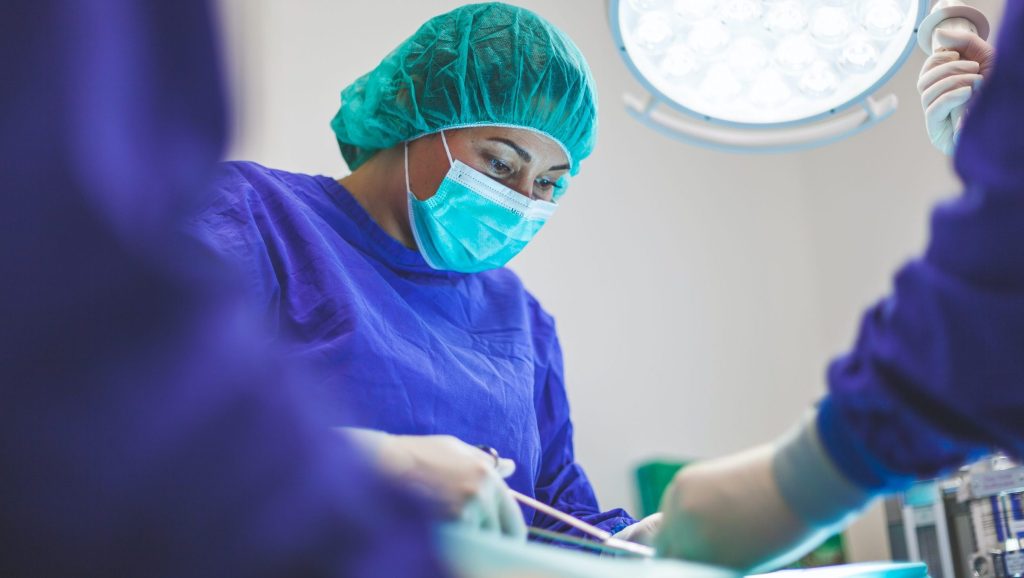
The procedure, which uses continuous X-ray imaging to guide a catheter (a long, thin tube) inside a vein to travel through the heart and reach the lungs to remove dangerous blood clots, was first performed in March 2024, through a pilot project. Since then, over 50 have been performed in Edmonton.
“For post-operative patients where medication is not an option, immediate removal of the clots is essential to saving the patient,” said Dr. Kiran Reddy, one of several interventional radiologists in Edmonton who perform the new procedure.
“The risk of death is very high with post-surgical patients presenting with a pulmonary embolism, so the ability to act quickly and remove the clots in an interventional suite is a game-changer for patients.”
AHS says that many post-op. patients develop a pulmonary embolism — he sudden blockage of a major blood vessel or artery in the lung, usually by a blood clot — but they can’t take clot-busting medication after surgery, which is why the new procedure has been trialed and is now being offered.
One patient who had the procedure is 58-year-old Dave Batke, who collapsed and had a near-fatal blood clot while recovering from back surgery.
“My lungs were filled with clots,” said Batke. “I was gasping for air and it felt like I had a huge weight on my chest.
“I don’t know how long I was unconscious, but eventually, I started hearing my wife screaming my name.”
When battle arrived at the Royal Alexandra Hospital, he was given two choices: open heart surgery or a nonsurgical thrombectomy.
“I was definitely scared. But it was a no-brainer.”
During the procedure, an incision was made in his leg and a catheter was inserted into his vein and up to his lungs. From there, Dr. Reddy used suction to remove the blood clots.
“Dr. Reddy spent two hours cleaning out my lungs, including one clot that was eight inches long,” said Batke.
His doctor says the non-surgical procedure essentially sucks out the clots. One of Batke’s was roughly eight inches long.
“I was out of the hospital four days later feeling immediate relief from my chest. I had a life-saving procedure that didn’t involve invasive surgery. I am so thankful. It brings a lot of hope for others like me,” said Batke.
“Eventually you get back to work and you start to carry on in life, but in the back of my mind, the images and the experience get triggered, and I remember them, and I’ll quite often get emotional and just cry over the experience.”
AHS also noted that most patients are mildly sedated during the procedure, which usually lasts about an hour or two.