Edmontonians split on Mayor Knack’s performance, two-thirds say city on wrong track: poll
Posted November 2, 2026 6:01 am.
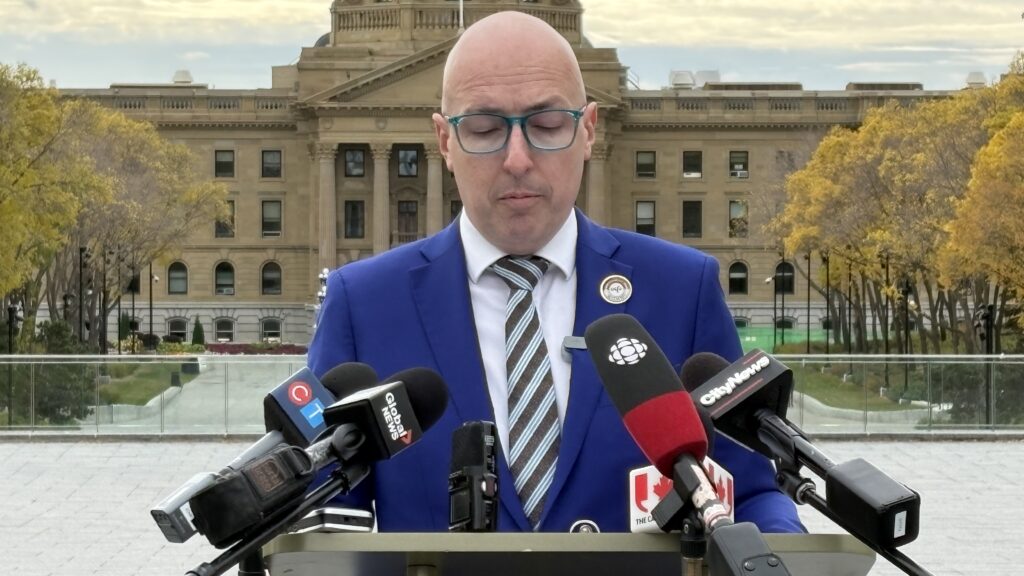
A new poll shows that only about a half of Edmontonians approve of Mayor Andrew Knack’s performance a year after he was sworn into office.
The Canada Pulse Insights survey, conducted for CityNews, found 51 per cent of Edmontonians consider Knack was doing a good job or a very good job. The other half disagreed, including about a fifth of the city’s residents saying he is doing a very bad job.
The findings also reveal that the dissatisfaction with the mayor could cost him his job if elections were held today, with 65 per cent of voters saying they want a change in the municipal leadership.
“(Knack) won on a minority of the vote, 38 per cent I believe, and only 35 per cent of Edmontonians think he deserves re-election,” said Will Daley, the senior vice-president of research and analytics with Canada Pulse Insights. “However the story is very different with younger voters and renters in Edmonton who are very much Knack’s base of support.
“So fortunately for Knack, he’s one year into a four-year term, so he has plenty of time to make this up. But clearly, Edmontonians’ patience is running thin.”
Knack’s colleagues in the city council only did marginally better with 55 per cent saying their ward councillors were doing a good job and 40 per cent saying they deserved another term.
The poor ratings also showed a concern among Edmontonians about the city’s future with nearly two-thirds of respondents saying the city was heading in the wrong direction. Three in four residents say the mayor and the city council as a whole were out of touch with their needs.
“Edmontonians are really looking to their leadership to make some changes,” said Daley.
“(Knack) inherited a budget with a 6.9 per cent increase that was not his own, and is not going to do anything other than shore up the city finances. So that’s a difficult situation for Knack, but he’ll have a chance this November to put his own stamp on city finances when he negotiates his first budget as mayor.”
The survey also found 45 per cent of Edmontonians are proud of their municipality and how it operates.
The searing results come a year after Knack was sworn into office after winning about 38 per cent of the votes in the municipal elections held in October 2025.
Knack, a former three-term councillor for Ward Nakota Isga in west Edmonton, ran as an independent beating out fellow veteran councilman Tim Cartmell and a slate of other candidates. During the campaign he positioned himself as a progressive choice convincing a number of undecided voters in the last stretch of the campaign.
However, some of Knack’s policies as mayor like the changes to housing regulations to allow high-density infill development proved to be unpopular with residents. Last month, the provincial government intervened asking the city to roll back its zoning bylaw.
While Edmonton’s results were generally negative, Calgary residents were far more enthusiastic about their municipal government. Three-quarters of Calgarians approved of Mayor Jeromy Farkas’ performance, and 65 per cent saying they he deserved another term. Far more Calgarians, about 64 per cent, said they were proud of their city and how it operates.
“Sixty-seven per cent say their ward councillor is doing well in Calgary versus 35 per cent in Edmonton, so the sort of general split of optimism versus pessimism persists at the city council level,” added Daley. “And again, when we’re looking at whether it’s the good job, bad job, or whether the city is heading in the right direction, we’re seeing that same split.
“When we look at whether city hall is in touch or out of touch, it’s a similar story. A majority of Calgarians, 56 per cent, say that city hall and the mayor are out of touch with their needs versus 75 per cent in Edmonton.”
This survey was conducted among 383 adults living in Edmonton and 401 adults living in Calgary between Sept. 30 and Oct. 9, 2026. The data were weighted to 2021 Census benchmarks by age and gender within each city. The margin of error for a comparable probability-based random sample of the same size is ±4.9 percentage points for Calgary and ±5.0 for Edmonton, 19 times out of 20.