Carney says the U.S. can’t dictate the terms of trade talks ahead of CUSMA review
Posted April 22, 2026 7:50 am.
Last Updated April 22, 2026 11:45 am.
Canada will not make any more concessions to the United States ahead of negotiations on the continental trade pact, Prime Minister Mark Carney said Wednesday as he insisted Washington will not be allowed to dictate the terms of the talks.
Carney was responding to a Radio-Canada report citing officials who said the Americans are imposing an “entry fee” on trade talks with Canada and are demanding concessions before negotiations begin.
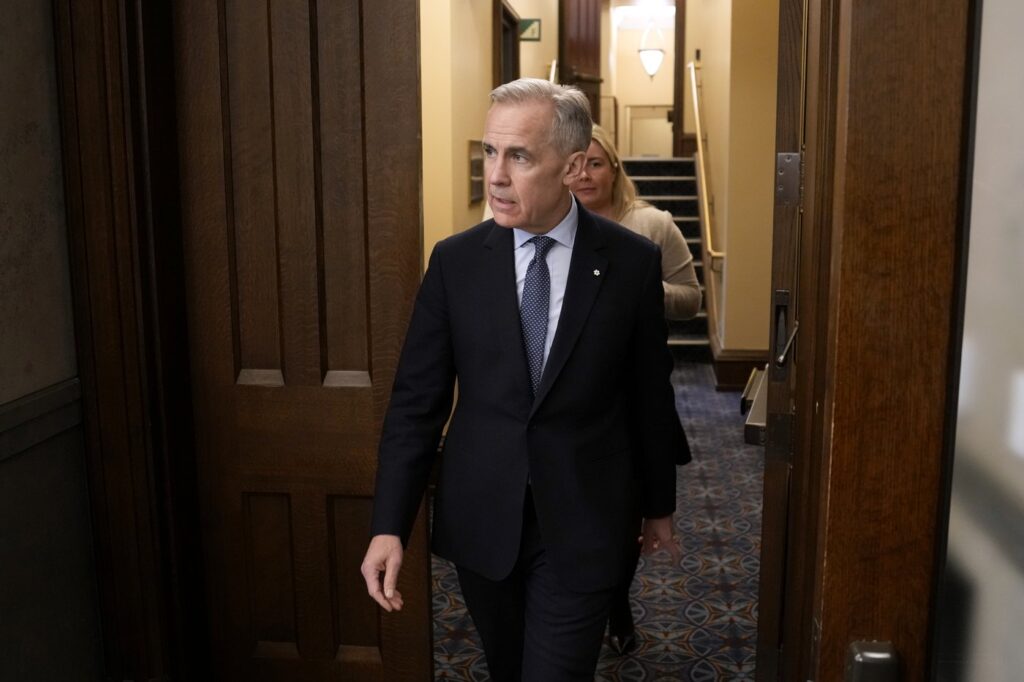
“It’s not a case of the United States dictates the terms. We have a negotiation, we can come to a mutually successful outcome. It will take some time, and we will take the time,” Carney said as he arrived on Parliament Hill Wednesday.
The Canada-U.S.-Mexico Agreement is up for mandatory review this year. Mexico and the U.S. agreed to begin formal talks on that review in January but Canada and the U.S. have not reached that point yet.
When asked directly if Canada should make any more concessions to the U.S. to get the Trump administration to the table, Carney said, “No.”
Earlier in the scrum, he said in French that Canada will seek concessions from the U.S., but will not make any concessions.
The prime minister said there are “multiple levels of contact” between Canadian and American officials and both sides have their own lists of trade irritants.
“We’ll sit down and work through those issues with the broader approach in the negotiation. We’ve made some counter-proposals … and the time will come to really roll up our sleeves,” Carney said.
United States Trade Representative Jamieson Greer told a Capitol Hill committee Wednesday that Canada and the U.S. have different priorities on trade.
He said that while Canada is looking to build more trading relationships with international partners, the U.S. is trying to “correct for the problems of globalization.”
“Those are two models that don’t fit together very well,” Greer said.
Greer said that if Canada continues down that path, the U.S. will need to take another look at country of origin rules to ensure the U.S. is not “disadvantaged.”
Dominic LeBlanc, the minister responsible for Canada-U.S. trade, did not take reporters’ questions as he entered the caucus meeting Wednesday.
Foreign Affairs Minister Anita Anand said being at the table with the U.S. is of “the utmost importance.”
“That, in this moment, is significant and will continue to occur until we reach a place where Canada’s interests are well protected and represented in the formal outcome,” Anand said.
Finance Minister François-Philippe Champagne, who was in Washington last week, said Wednesday Canada has made it clear that an agreement needs to be reached on U.S. sectoral tariffs on Canada’s steel, aluminum, automobiles and softwood lumber.
Janice Charette, Canada’s chief trade negotiator, said Tuesday during a panel discussion in Ottawa that Canada already has made significant concessions by dropping the digital services tax, issuing millions of dollars in refunds to tech companies and ending retaliatory tariffs.
A recent report from the Office of the United States Trade Representative identifies provinces refusing to stock American alcohol and high tariffs on some American dairy products as trade irritants.
Carney has promised to protect Canada’s supply management system for dairy, poultry and eggs during trade talks with the U.S.
John Barlow, Conservative agriculture critic, said Carney’s recent description of the current trade relationship with the U.S. as a “weakness” sent “shivers” through Canadian food producers who depend on the American market.
“You can’t just find that market somewhere else in the world. You can say, ‘Well, we need to diversify.’ That is not replaceable,” Barlow said.
Barlow said that while Canada “obviously” wants to protect supply management, it’s unwise to take it off the table in trade talks with the U.S.
“To see Mexico now on the eve of perhaps having an agreement with the United States and us on the outside, I think it would be a very bad deal if the United States and Mexico come to an agreement and then come to Canada and say, ‘Here it is, take it or leave it,'” he said.
“The key right now is to get back to the negotiating table and start those discussions as quickly as possible.”
Bloc Québécois Leader Yves-François Blanchet said it’s encouraging that the two sides say they are willing to negotiate, but negotiation requires “serious people” at the table.
“We want this to be done reasonably, so please, tell the president not to sit at this table. We’ll do that between serious people and then it will go up to Mr. Carney and Mr. Trump and a deal will be completed,” Blanchet said.
The U.S. is also pushing back against the “Buy Canadian” policy, which gives priority to Canadian products and workers on projects worth more than $25 million.
With files from Catherine Morrison