Water main break impact 2,000 Calgary homes
Posted December 31, 2025 8:26 am.
Last Updated December 31, 2025 3:11 pm.
The City of Calgary says water restrictions are in place until further notice after a water pipe in the city’s northwest connected to the Bearspaw South Feeder Main broke on Tuesday.
Nancy McKay, the director of the city’s water services, says the “catastrophic break” was found east of Sarcee Trail and the 16 Avenue Northwest interchange, along the same feeder main that broke in June 2024, which received a series of repairs.
At the time, residents in the area near the pipe rupture were left without water, and Bowness and Montgomery were placed under a boil water advisory. Calgarians were asked to conserve water for weeks during the summer of 2024 after the initial incident.
“We will lift restrictions as soon as we can,” she said in a news conference on Wednesday.
“Repair can — depending on what we get in there — seven to 10 days is what we looked at when we had one repair there. But we don’t know until we get eyes, and what I want to do is make sure that we’re giving you the best information as soon as we have it.”
Calgary Emergency Management Agency (CEMA) Chief Susan Henry says it happened at around 8 p.m. in the area of the Sarcee Trail and 16 Avenue Northwest interchange. She says the city’s water services team shut the water off and found the break’s location in the early morning.
For now, 16 Avenue, east of Sarcee Trail, is closed in both directions.
Chris Graham, involved in the city’s infrastructure, explains that the pipe was being monitored continuously with “acoustic fibre optic equipment,” and that the system was working at the time of the failure.
“There was no wire snaps or any evidence before the failure, but the system was being fully monitored,” he said.
“There was nothing in the monitoring or in the operation of the pipe, the flows, the pressures, that would have indicated an issue before the pressure dropped at the control room.”
The location also isn’t the same as the one that broke in 2024 and was replaced with a pipe received from San Diego, Graham says.
“That piece of particular pipe is already in the ground. It was a piece of pipe that was installed in 1975 that failed,” he said.
With the assessment underway, Henry says the size of the break and its impacts led to the municipal emergency plan being activated.
This means Stage 4 Water Restrictions are in place, along with a boil advisory for the Montgomery, Parkdale, and Point McKay communities.
“We are currently deploying water wagons to the communities that have been affected by the boil water advisory,” she said.
With sixty per cent of the city’s water flowing from the Bearspaw Feeder Main, McKay says adjustments were made to move water differently to flow water from the Glenmore Water Treatment Plant throughout the city.
“This means that we’re relying on less water to meet the demands of the entire city and the surrounding region and communities that rely on city of Calgary water in order to make sure that we have enough water for essential needs,” she said in a news conference.
‘New Year’s Eve is not cancelled’
As the city is asking Calgarians to take responsible measures to reduce their water use, Mayor Jeromy Farkas says there should be confidence to be able to celebrate 2026.
“To be clear, New Year’s Eve is not cancelled,” he said.
“We can still proceed, but we have to do so in a way that recognizes the constraints that Calgarians exist in right now. So while the city is still assessing the situation, we’re committed to providing information as it becomes available.”
He says council is going to hold city administration accountable, and says that funding the needed infrastructure is going to be their focus over the coming days here, including focusing on plans to fully replace the pipe, which are already underway.
“We have learned from the previous time that this happened within the first few hours. We’re already days ahead,” Farkas said.
“We are going to be relentless and get this done.”
Boil advisory, Stage 4 water restriction in place
Stage 4 Water Restrictions are in place, so outdoor water use is being limited for rinks, snow-making or other large outdoor water usage. Indoor facilities such as pools, rinks and recreation facilities are advised to implement their water reduction plans.
The following applies to Calgarians and residents of Strathmore, Airdrie, Chestermere and Tsuut’ina Nation:
- Limit showers to under three minutes.
- Flush toilets only when necessary.
- Run dishwashers and laundry only when full.
Henry also says a boil water order is in effect for portions of Montgomery, Parkdale, and the Point McKay communities.
All residents and businesses in the area are being asked to bring all tap water to a rolling boil for one full minute prior to any consumption, including:
- Drinking.
- Brushing teeth.
- Cleaning raw foods.
- Preparing infant formula or juices.
- Making ice, etc.
However, the city says water used for bathing or for laundry does not need to be boiled. The city says, “Residents may instead choose to purchase bottled water for consumption for the duration of this advisory.”
The advisory is in effect until further notice. More information on the boil water advisory can be found on the Alberta Health Services website here.
The City of Calgary says about 2,000 homes and 100 businesses have been impacted by the watermain break in the Bowness community.
Another update is expected Thursday.
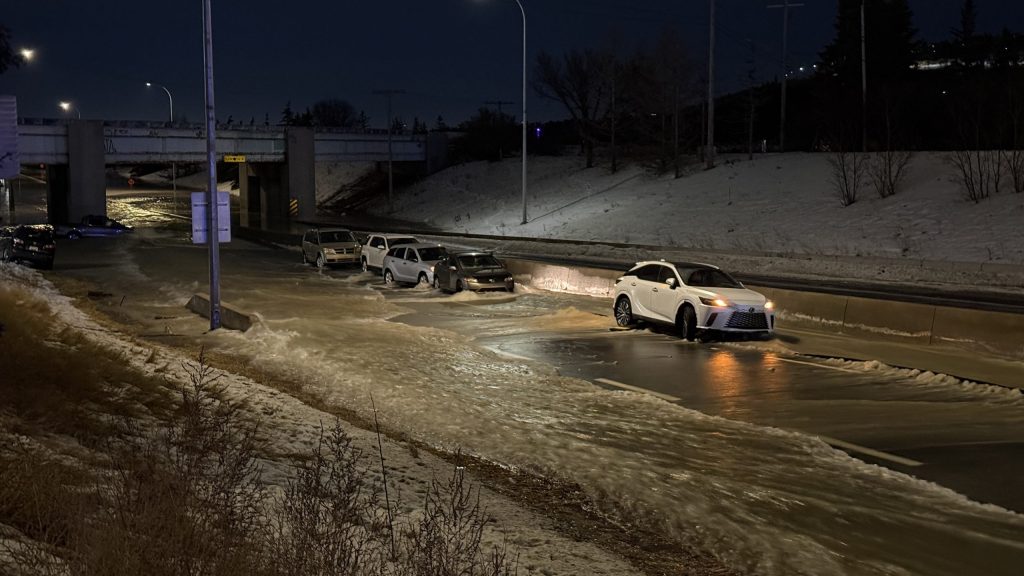
13 rescued from vehicles trapped by water flow
Thirteen people were rescued by the Calgary Fire Department (CFD) and Calgary police after they were stuck in freezing water, caught by the flow.
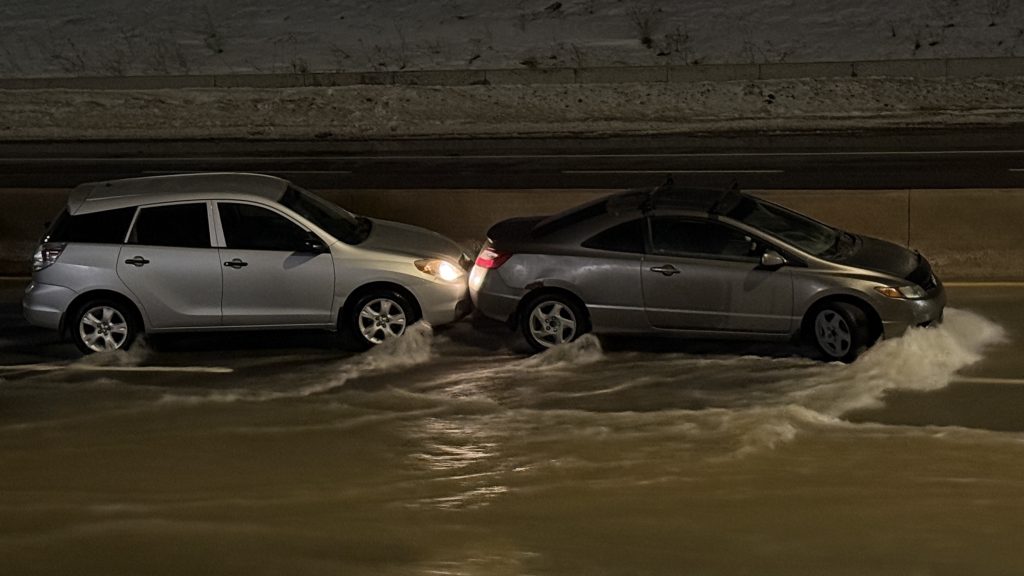


Battalion Chief Alistair Robin says several vehicles were attached to the incident, but crews heading westbound were stopped because of “several 100, maybe even 1,000 litres of water” at the time.
“The eastbound truck from Valley Bridge that got on scene the quickest and the closest, and they were able to see at that time about six vehicles that were stuck in the water flow where people had started to exit their vehicles, and they were up on their hoods and the roofs of their cars just to try and get out of the water,” he said.
“So they had actually continued to drive up into that torrent of water and got caught in a place where they couldn’t turn out.”
The CFD aquatics team went to seven different vehicles in total and rescued 13 people, including three children, and moved them to a safe spot.
While videos and images online suggest the water was deep enough to reach the roof of a vehicle when it initially happened, Robin says it was deep, but not that deep.
The aquatic teams waded through the water to each vehicle at around waist level, and it only looked deep at times because the water was pushed upwards “like a rock in the river.”
“It was moving. It wasn’t quite as high — it wasn’t quite as deep as that,” he said.
“It sort of forces the yield to go up higher on the object that’s stationary. But the actual water wasn’t as deep.”
He says the water dissipated quickly because of the field structure at Shouldice, where the water was held by the jersey barriers — concrete dividers — on 16th Avenue. “which caused the water to stay fairly deep and trap those vehicles in there.”
No injuries were reported, and Robin adds that the teams are trained for these kinds of incidents.
With files from Nadia Moharib