What’s next after Alberta orders teachers back using notwithstanding clause?
Posted October 27, 2025 7:32 pm.
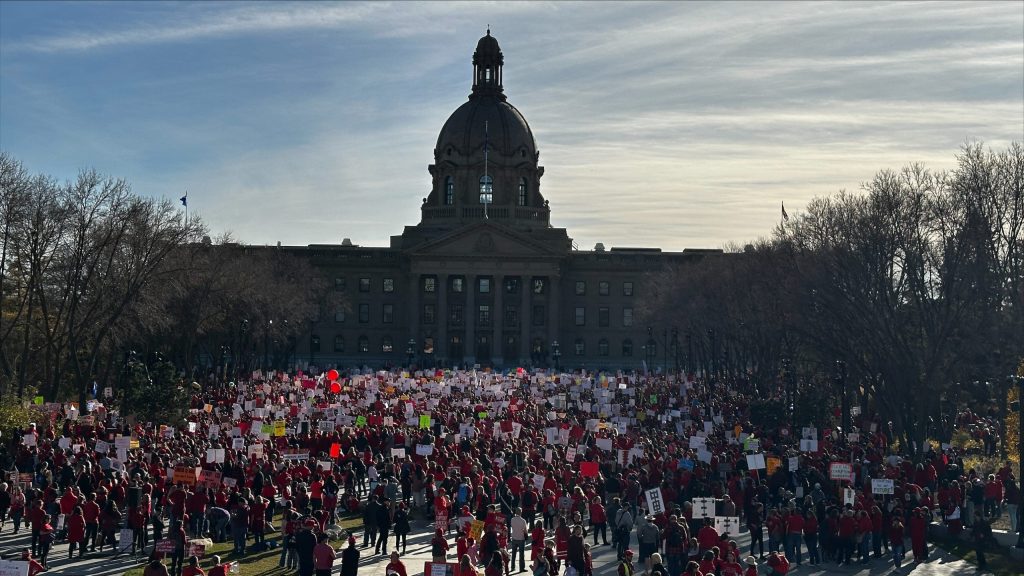
In a move to end the largest teachers’ strike in Alberta’s history, Premier Danielle Smith’s government introduced legislation Monday invoking the Charter’s notwithstanding clause to mandate the return of 51,000 educators to classrooms across the province.
The unprecedented walkout, which began in early October, saw tens of thousands of teachers walk out over unresolved issues, including class sizes, compensation, and working conditions. If the bill passes, students will be back in classes on Wednesday.
While the government’s bill effectively halts the strike, legal experts say it does little to resolve the underlying tensions—and may ignite a new phase of labour unrest.
Employment lawyer Puneet Tiwari of Levitt LLP says the use of the notwithstanding clause strips teachers of their ability to challenge the legislation under the Canadian Charter of Rights and Freedoms.
“Teachers could have launched a Charter challenge, saying this act by the Alberta Legislature breaches the Canadian Charter of Rights and Freedoms,” Tiwari explained,” Tiwari explained.
But because Alberta has invoked the notwithstanding clause, that legal path is now closed. Tiwari adds that teachers who fail to comply with the back-to-work order could face serious consequences.
“If you’re legislated back and you don’t show up, it’s job abandonment,” he said.
A Shift to ‘Work-to-Rule’?
Although the strike has been legislated to end, Tiwari warns that the conflict is far from resolved. With few legal options remaining, teachers may turn to a “work-to-rule” strategy—a form of protest where staff perform only the minimum required duties.
“We’ve seen this play out before in Alberta, nearly 20 years ago,” Tiwari said. “Teachers return to work, and there is no actual agreement they are okay with. We are going to see a work-to-rule strike.”
Such action could have a profound impact on students and families, according to Tiwari.
“Work-to-rule is most painful for students,” he recalled. “No extracurricular activities, no extra help, no sports teams. It can have a long-lasting effect.”
The government’s decision may have ended the immediate disruption, but it has also intensified the standoff between educators and the province.
The move also puts Smith’s government on a potential collision course with more than 350,000 workers in other provincial unions, which promised an “unprecedented response” if the government invoked the clause to override teachers’ constitutional rights to assemble.